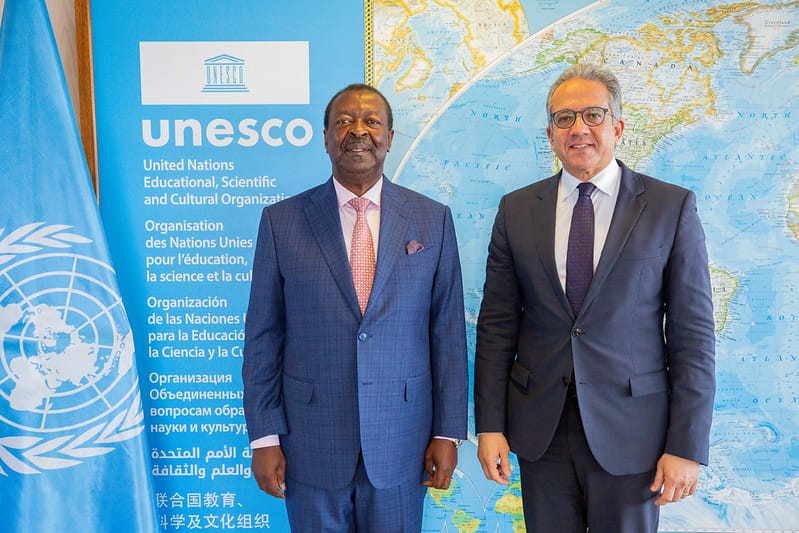
Kenya is seeking to position Nairobi as UNESCO’s regional hub anchor in Africa, Prime Cabinet Secretary Musalia Mudavadi has said, citing the country’s growing diplomatic influence and strategic role on the continent.
Mudavadi made the remarks during talks with UNESCO Director-General Prof. Khaled Ahmed El-Enany Ali Ezz at the organisation’s headquarters in Paris, France, as Kenya pushes for the elevation and expansion of the UNESCO Regional Office for Eastern Africa based in Nairobi.
He said Kenya is leveraging its progress in infrastructure development, peace and security, political stability, economic growth, and diplomatic reach to strengthen UNESCO’s presence in the region.
Mudavadi noted that the proposal aligns with ongoing United Nations reforms aimed at improving efficiency and coordination across agencies.
“In line with ongoing UN80 reforms, and on strengthening UNESCO’s presence in the region, Kenya remains steadfastly committed to UNESCO’s ideals and objectives, guided by Vision 2030 and the Sustainable Development Goals,” Mudavadi said.
He added that Kenya would continue to work closely with UNESCO and its member states to promote inclusive and equitable development across the organisation’s mandate areas, including education, science, culture, and technology.
Mudavadi said elevating Nairobi’s role would enhance operational coordination among UN agencies already headquartered in the city, while also creating employment opportunities for Kenyans.
He praised Kenya’s permanent delegation to UNESCO for advancing national interests by leveraging the organisation’s expertise in education, natural sciences, social and human sciences, culture, the blue economy, and information and communication technologies.
“This strategic approach ensures that Kenya’s voice is not only heard but also influential on the global stage, promoting our national interests through UNESCO’s platforms, programmes, and initiatives,” he said.
The Prime CS noted that Kenya aims to expand opportunities in Science, Technology, Engineering, Arts, and Mathematics (STEAM) to develop sustainable solutions to societal challenges.
He said the ultimate objective is to strengthen Kenya’s strategic positioning within UNESCO and deliver tangible benefits to citizens.
Mudavadi said Kenya would also use an upcoming UNESCO Executive Board meeting in April to mobilise funding for water resource projects, including plans to harness underground water in Turkana County once feasibility studies are completed.
As Cabinet Secretary for Foreign and Diaspora Affairs, Mudavadi said Kenya is seeking to place more of its citizens in influential positions within UNESCO and affiliated bodies to enhance the country’s global influence and partnerships.
He added that Kenya intends to capitalise on its digital economy and advance its national artificial intelligence strategy, including expanding UNESCO-supported youth programmes in AI, coding, and entrepreneurship.
He also requested UNESCO’s support to fast-track the establishment of a Centre for Heritage Development and Training in Kenya.
UNESCO welcomed Kenya’s leadership in cultural heritage, including its membership in the World Heritage Committee from 2023 to 2027.
Mudavadi said discussions also covered sustainable ocean governance and the blue economy, with UNESCO confirming support for Kenya ahead of the Ocean Conference scheduled to be held in Mombasa in June 2026.
Both sides agreed to deepen cooperation to support Africa’s leadership in knowledge, innovation, culture, and sustainable development.































Comments
Sign in with Google to comment, reply, and like comments.
Continue with Google